Showing posts with label chinese. Show all posts

February 2, 2010

The Spread of Chinese Tea Culture to Japan and Korea

tea

Along with many other cultures (including worshiping ancestors), the culture of Chinese Tea spread to Japan, Korea and also the rest of the world.


Traditionally, China had been the source of culture for Japan and Korea. Besides, Chinese tea, Japan and Korea absorbed many other material and spiritual arts from China too. Japanese and Korean students studying in china were the first to be introduced to this Chinese culture.


It was in 593 AD, during the reign of Emperor Wendi of the Sui Dynasty (581-601AD), that China introduced teat to Japan together with other cultures, art including Buddhism.


In 804AD, some of the monks of the Japanese sect of Buddhism (Japanese Tiantai Sect of Buddhism) came to China to learn. It was during the reign of the Emperor Dezong of the Tang Dynasty. The next year, they returned to Japan with Buddhist scriptures including Chinese Tea seeds, which were planted on the mountains of Japan.


They learnt how to use stone mortar to process the tea, as well as the skills of processing tea by steaming, pounding and roasting. Soon, the Japanese were encouraged to drink tea like the Chinese people of the Tang Dynasty.


They boiled cake tea, and added condiments such as sweet kudzu vines and ginger. However, due to the limited supply of tea, only the rich and Japanese of royalty, including the Buddhist monks had the privilege of drinking tea.


During the reign of Emperor Hirayasu, there was almost no contract between Japan and China. This was during the 200 years from the Five Dynasties (907 – 960AD) to the Song and Liao Dynasties. Tea drinking soon became extinct.


It was not until the Southern Song Dynasty (1127-1279AD) that a Japanese monk called Eisai reintroduced tea to Japan. He studied in China at the age of 21. In his explorations in Mingzhou Prefecture, Zhejiang Province, he traveled through mountains and visited many temples. Tea drinking in China was very prevalent then, and he immersed himself in the Chinese tea culture as he lived in China for 24 years. He learnt the skills and art of Chinese tea.


After Eisai returned to Japan, he planted tea trees and wrote the book, “Health Preserving by Drinking Tea” which incorporated many of the principles of Tea Culture by Lu Yu in his book, “The Book of Tea”. Eisai became known as the founder of the art of Japanese Tea.


During the Yuan (1271-1368AD) and Ming (1368-1644AD) dynasties, Japanese monks continued to come to China. They continued to master tea drinking skills from the Buddhist monks and scholars, and later created a Japanese branch of Tea art. They improved on the Chinese tea art and also refined the skills of planting, producing and drinking tea.


As for Korea, tea was introduced from China to Korea from 632-646AD. It was found on a tablet inscription for Zhenjian, a prominent Korean monk (755-850AD), written “If Chinese Tea is received again, put it into a stone pot and boil it with firewood.”


Later tea drinking became a temple ceremony initiated in Korean temples. The Koreans were particular about the source of good water for the process of making Tea. They paid attention to the art and the quality of water used.


In 828AD, during the reign of Emperor Wenzong of the Tang Dynasty, a Korean envoy to China, brougt back with him Tea seeds from China to Korea. From then on, the Koreans began to plant and produce tea.


Presently, Korea produce more than 1.5 million kilograms of tea annually in over 1334 hectares of major tea plantations.


Author:

Though tea drinking was culturally Chinese, the tradition of this drink had spread far and wide. Earlier in the introduction, you can see that tea drinking was largely combined with spiritual arts. Tea was introduced in the temples, drank by monks (besides the rich and royalty), and taught in Buddhist teachings. However, it is my conclusion that the act of drinking Chinese tea (including Japanese and Korean tea), is not spiritual at all and has no effect on the spiritual life of a person.


So whether you are a Christian or not, drinking tea as a health drink, recreation drink or just quenching your thirst is most enjoyable.

May 25, 2009

A wedding in the afterworld

minghun


This report came out in The Star newspaper page N38, on the 25th May 2009.


A SPECIAL “wedding ceremony” was held in Segamat on Saturday. Both the bridegroom and bride were dead.

The 19-year-old youth died in a car accident but had “told” his family members that he had met his dream girl, China Press reported.

The bridegroom, who passed away in 1996 met his bride, who died from a sickness in 1973 when she was 18, during the Hungry Ghost Festival.

He had told his family members of his wish to marry through a medium in Segamat last year but the family did not take it seriously.

However, the man’s mother felt uneasy and decided to see the medium again last month.

Finally, the family approved of the marriage and the “wedding ceremony” was held.

The medium, who represented the bride, underwent a Chinese traditional wedding ceremony including serving tea to the elders of the family. The bridegroom was represented by his brother.


You can also view this story on line here:

http://thestar.com.my/news/story.asp?file=/2009/5/25/nation/3974722&sec=nation


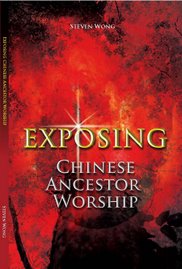
In the book, “Exposing Chinese Ancestor Worship” on page 25, i mentioned that this practice is actually called “minghun” or afterlife marriage. This practice was banned during the era of Chairman Mao Tse Tung when Communism was in full force. Subsequently, China has become liberalized and the government has allowed their citizens to pursue most of their religious activities as long as it is apolitical.


The root of this practice comes from ancestor worship.


In the quest for commercial gain, the Taoist priests have embarked on riding on the superstition of many Chinese people. By showing overt concern for the dead, fears of retaliation from the afterlife were heaped on the naive Chinese people. Most will fall for this ruse of wanting to provide adequately for the dead, including providing a bride or bridegroom for them in the afterlife.


In the end, the priests have mixed into ancestor worship, some acts of spiritism, by calling on the dead, and hoping into a pretentious trance. In the desire to convince the living to part with their money, elaborate “scammish” designs have to paid for, and in the end, the only benefactors were the priests.


As a Christian, we should have no involvement in the afterlife for it has been already clearly stated in Deuteronomy:


Deu 18:10 There shall not be found among you anyone who makes his son or his daughter to pass through the fire, or that uses divination, an observer of clouds, or a fortune-teller, or a witch,
Deu 18:11 or a charmer, or a consulter with familiar spirits, or a wizard, or one who calls to the dead.
Deu 18:12 For all that do these things are an abomination to Jehovah.


May God show us greater wisdom and discernment.


July 2, 2008

China exporting its tea drinking culture

chinese tea

CHINA'S TEA DRINKING CULTURE


Direct from the China National Tea Museum in Hangzhou, this interactive exhibition is the first of its kind to be showcased across the UK. Launching at Asia House, the exhibition will then go on tour to various locations across the UK.
The exhibition explores the long history and culture of tea as well as its health and medicinal qualities in both ancient times as well as in contemporary China today...BBC


The above article from BBC looks like China is not just exporting its people but more and more of its culture will be exported. This reminds me about the time when Great Britain was colonizing the rest of the world and attempted to export the English culture and all its do, to the rest of the world.


Today, China as a major superpower, is attempting to influence the rest of the world about its greatness and if successful, will rewrite a new world order.


Technorati Tags: ,,

October 29, 2007

Who are the Overseas Chinese?


The Overseas Chinese are people of Chinese birth or descent who live outside the Mainland China region, which in this case includes Taiwan, Hong Kong and Macau.

Before the handover of Hong Kong and Macau back to Mainland China, the People's Republic of China (PRC) considers the residents of these two areas as "Oveseas Chinese Status". However, after the official handover back to the motherland, the Status was removed.

Some Chinese people in other lands who are of partial Chinese ancestry i.e. either one of their parents or their grandparents is Chinese, also do consider themselves as Overseas Chinese.

Below is an uncompleted list of Overseas Chinese in the various countries:

Total population of Overseas Chinese = 39,379,784

Regions with significant populations

Majority populations

Singapore 2,684,936
Christmas Island, Australia 1,045

Minority populations

Indonesia 7,566,200
Thailand 7,153,240
Malaysia 7,070,500
United States 3,376,031
Canada 1,612,173
Peru 1,300,000
Vietnam 1,263,570
Philippines 1,146,250
Burma 1,101,314
Russia 998,000
Australia 614,694
Japan 519,561
Cambodia 343,855
United Kingdom 296,623
France 230,515
India 189,470
Laos 185,765
Cuba 170,000
Brazil 151,649
New Zealand 147,570
Netherlands 144,928
South Korea 137,790
Panama +100,000

In Southeast Asia and particularly in Malaysia and Singapore, the countries classifies the Peranakan as Chinese despite their partial assimilation into the Malay culture.

May 1, 2007

Honor or Worship


Nobody can deny that to honor our ancestors is the right thing to do.
We would not be alive in this world today if not for our parents, grand parents, great grandparents, great great grandparents, and great...great...etc.

It was in the purpose of God that we came from this lineage just as Jesus' lineage was specified in the Bible for all generations to observe - and all Bible scholars to study.

Lest I be accused of dishonoring my ancestors, there is a stark difference between honoring them while they are alive and worshiping them when they are dead.

I believe, that the current practice of ancestor worship in many countries is worship and that is wrong. Worship is only to be accorded to God and no one else. All other forms of worship is idolatry and especially worship to a created being - man.

Let's decide to honor them, respect them - and not worship them.